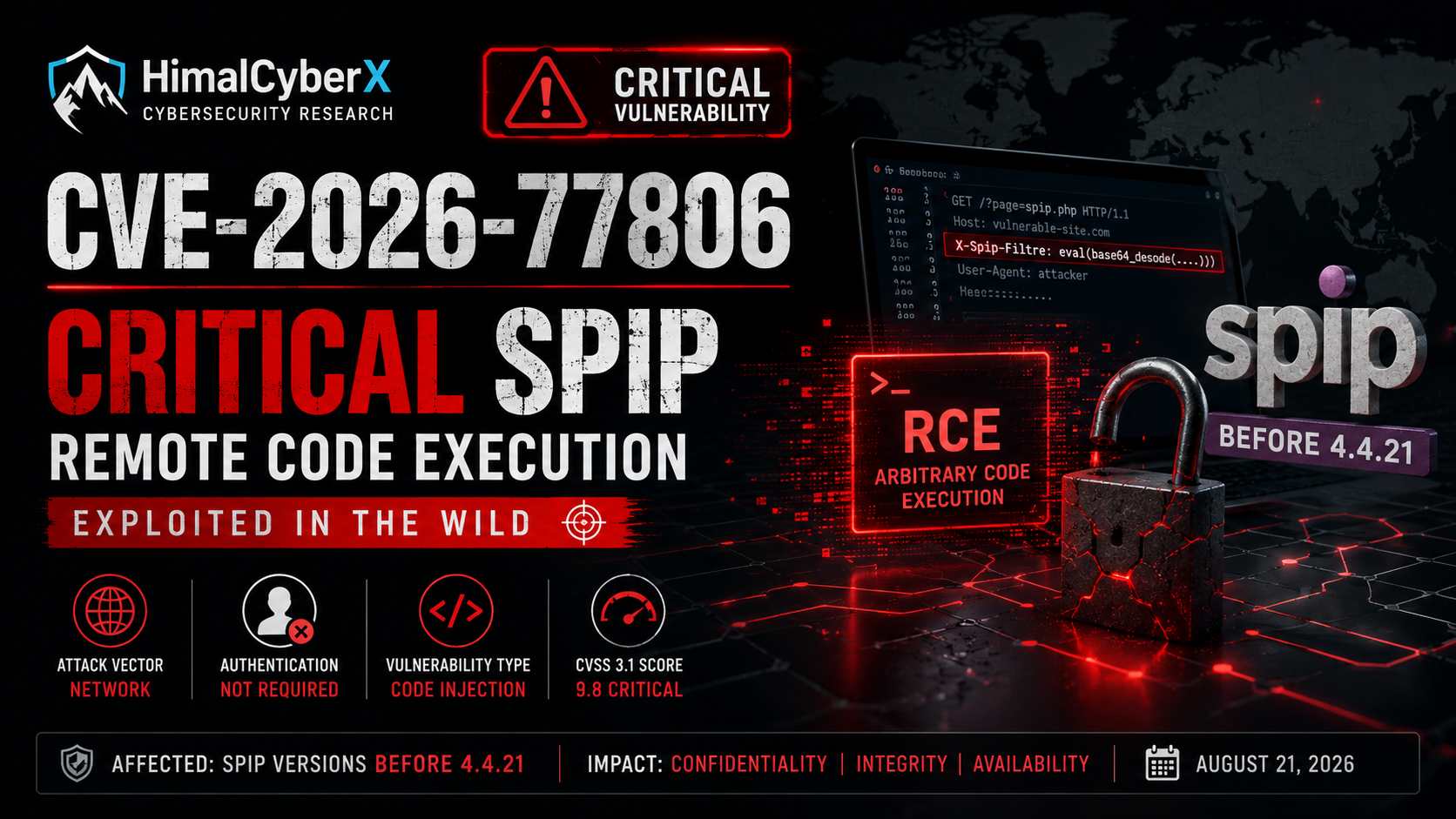
CVE-2026-77806: Critical SPIP Remote Code Execution
CVE-2026-77806 is a critical code-injection vulnerability affecting SPIP versions before 4.4.21. The vulnerability is particularly important for defenders because it can allow an unauthenticated remote attacker to execute arbitrary code against a vulnerable system.
The National Vulnerability Database (NVD) records the vulnerability as exploited in the wild during August 2026. The issue is associated with improper handling of the X-Spip-Filtre HTTP request header and is classified as CWE-94: Improper Control of Generation of Code.
For organisations operating internet-facing SPIP installations, the combination of remote accessibility, no authentication requirement and reported exploitation makes this an urgent vulnerability-management priority.
Vulnerability at a Glance
AttributeDetailsCVECVE-2026-77806ProductSPIPAffected versionsBefore 4.4.21Vulnerability typeCode Injection / Remote Code ExecutionCWECWE-94Attack vectorNetworkPrivileges requiredNoneUser interactionNoneCNA CVSS 3.19.8 — CriticalExploitationReported in the wildFixed releaseSPIP 4.4.21
The CVSS vector published through the CVE record is AV:N/AC:L/PR:N/UI:N/S:U/C:H/I:H/A:H, indicating network reachability, low attack complexity, no privileges or user interaction, and potentially high impact across confidentiality, integrity and availability.
What Is SPIP?
SPIP is an open-source content management and publishing system used for building and managing websites.
Like other content management systems, a vulnerable SPIP installation can become particularly significant when it is exposed directly to the internet. A weakness in the application may provide attackers with a path toward the underlying web environment.
This is why organisations should maintain an accurate inventory not only of operating systems and servers but also of the web applications and CMS platforms running on them.
How CVE-2026-77806 Works
According to the NVD description, the vulnerability relates to code injection through the X-Spip-Filtre HTTP request header, which is mishandled by SPIP's analyse_resultat_skel functionality.
The security consequence is significant: an unauthenticated remote attacker may be able to cause arbitrary code execution on an affected system.
From a defensive perspective, the key point is that exploitation does not require the attacker to first obtain a legitimate SPIP account.
This substantially changes the risk profile compared with vulnerabilities that require administrator access or successful social engineering.
Why the 9.8 CVSS Score Matters
The CNA assessment gives CVE-2026-77806 a CVSS 3.1 score of 9.8 — Critical.
Several characteristics contribute to that severity.
The attack vector is network based, attack complexity is rated low, privileges are not required, and exploitation does not depend on user interaction.
Successful exploitation may also have a high impact on confidentiality, integrity and availability.
However, defenders should not prioritise vulnerabilities based on CVSS scores alone.
The more important combination here is:
Critical technical severity + remote accessibility + no authentication + reported real-world exploitation.
That combination makes CVE-2026-77806 particularly important for organisations with exposed SPIP installations.
Who Is at Risk?
SPIP versions before 4.4.21 are identified as affected.
The official SPIP release archive confirms that version 4.4.21 was released on August 20, 2026.
Administrators should therefore identify SPIP installations across their environments and determine exactly which versions are deployed.
Priority should be given to systems that are:
Internet-facing
Running a vulnerable SPIP release
Hosting sensitive or business-critical information
Accessible from untrusted networks
Running with unnecessary application or operating-system privileges
An organisation that does not know where SPIP is deployed may have difficulty responding quickly, which demonstrates why software and asset inventories are an important part of vulnerability management.
Defensive Priority
HimalCyberX Defender Priority: CRITICAL
Organisations operating internet-accessible SPIP installations below version 4.4.21 should treat CVE-2026-77806 as an urgent remediation and investigation priority.
This assessment is based on four factors:
Remote network reachability
No privileges required
No user interaction required
Exploitation reported in the wild
The goal should not simply be to assign a severity label. Security teams should determine whether vulnerable systems actually exist in their environment, how exposed those systems are, and whether suspicious activity has already occurred.
Recommended Defensive Actions
1. Identify SPIP installations
Security and IT teams should first determine whether SPIP is present anywhere in their environment.
Check internet-facing infrastructure, application inventories, web-server configurations, cloud workloads and externally hosted systems.
2. Determine the installed version
Confirm the exact SPIP version running on each discovered installation.
Systems running a version before 4.4.21 should be considered affected according to the published vulnerability information.
3. Upgrade affected installations
Move affected systems to SPIP 4.4.21 or an appropriate later supported security release.
Updating the vulnerable software should remain the primary remediation rather than relying solely on perimeter filtering.
4. Review historical activity
Because exploitation has been reported in the wild, patching should not automatically be treated as proof that a previously exposed system was never compromised.
Where appropriate, defenders should review historical telemetry from vulnerable systems.
5. Reduce unnecessary exposure
Web applications should only expose services and interfaces that are actually required.
Network controls, reverse proxies, segmentation and least-privilege configurations can help reduce the consequences of application compromise, although these measures should complement rather than replace remediation.
What Should Defenders Look For?
Public vulnerability information establishes the existence and impact of the flaw, but reliable universal indicators of compromise should not be invented where authoritative sources have not provided them.
Instead, defenders investigating a potentially exposed SPIP server can examine available telemetry for anomalies such as:
Unexpected application or web-server behaviour
Unexplained modifications to application files
Unexpected new processes associated with the web environment
Suspicious outbound network connections
Unexpected account or permission changes
Unusual HTTP requests around the suspected exploitation period
Persistence mechanisms that cannot be explained by legitimate administration
These signals are investigative starting points, not CVE-specific indicators of compromise. Findings should be correlated with the organisation's normal baseline and other security telemetry.
Patch Versus Compromise Investigation
There is an important distinction between remediation and incident investigation.
Installing an updated version addresses the vulnerable software condition going forward.
It does not necessarily establish whether an attacker exploited the system before remediation.
For an internet-facing system that remained vulnerable during a period of reported exploitation, organisations should make a risk-based decision about whether additional investigation is warranted.
That could involve examining web logs, endpoint telemetry, file integrity information, authentication records and network activity.
HimalCyberX Analysis
CVE-2026-77806 illustrates an important weakness in vulnerability-management programs that rely too heavily on severity numbers.
A CVSS score can help describe technical severity, but it cannot answer all of the questions defenders actually need to answer:
Do we use the affected product?
Is it exposed to the internet?
Is our version vulnerable?
Has exploitation been observed?
Could the application compromise affect other systems?
Do we have sufficient telemetry to determine whether exploitation occurred?
For CVE-2026-77806, several of these risk factors align. The vulnerability is remotely reachable, requires no authentication or user interaction, has potentially severe impact, and has been reported as exploited in the wild.
For defenders, that makes asset discovery and exposure analysis almost as important as reading the CVSS score itself.
The broader lesson is simple: effective vulnerability management is about understanding exposure and real-world risk, not merely collecting CVE numbers.
Conclusion
CVE-2026-77806 should receive serious attention from organisations operating SPIP.
Affected versions before 4.4.21 may allow unauthenticated remote arbitrary code execution, and exploitation has been reported in the wild.
Administrators should identify affected installations, upgrade them appropriately, reduce unnecessary exposure and consider reviewing security telemetry where vulnerable systems were publicly accessible.
For security teams, the vulnerability also reinforces a broader principle: knowing what you run, where it is exposed, and how quickly you can investigate it is fundamental to effective vulnerability management.
References
Use actual clickable links in your site's References section: